
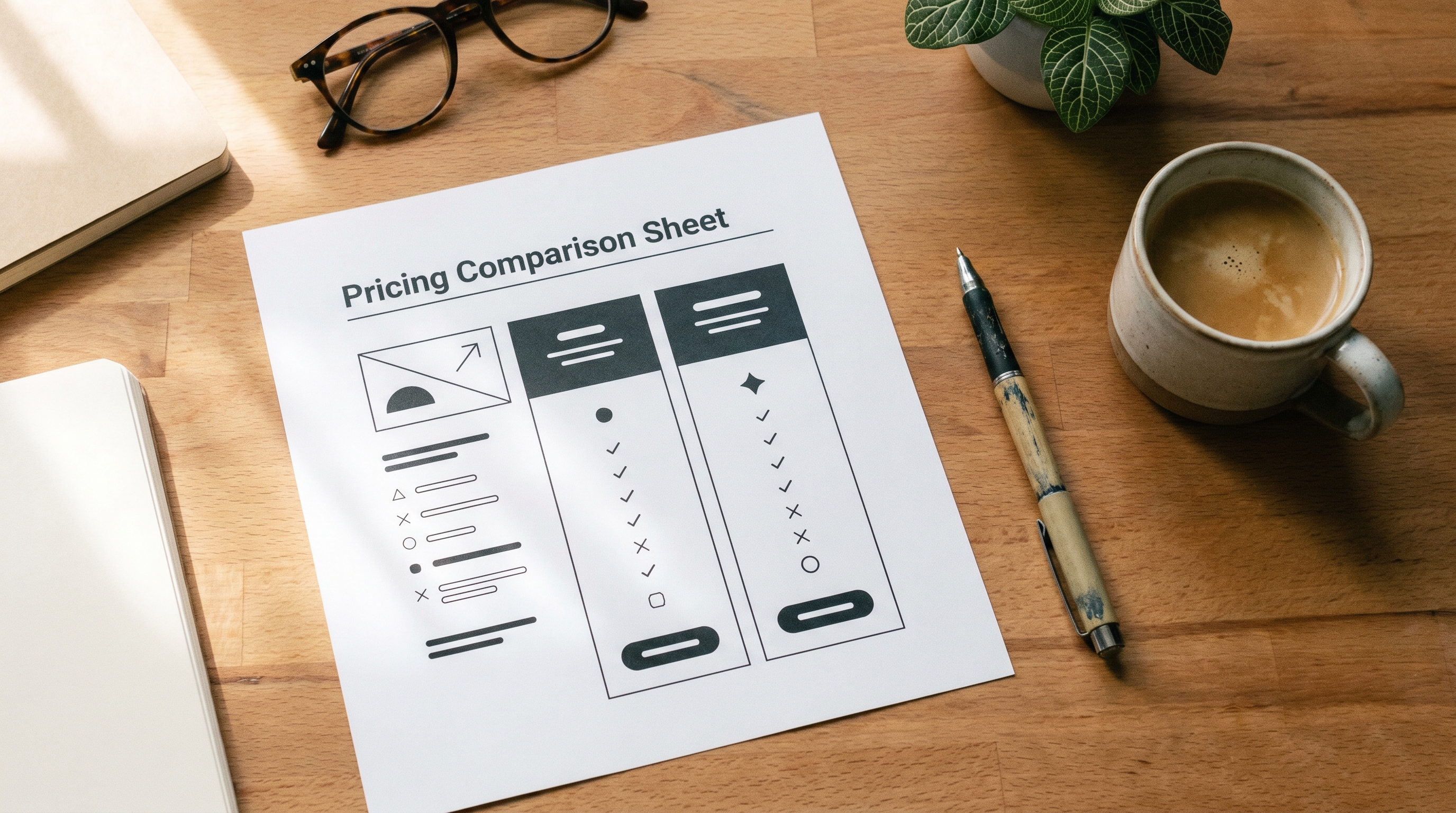
Why Your Buyers Almost Never Choose Rationally
Pricing decisions feel logical. Buyers tell themselves they are weighing features, costs, and return on investment before committing. But decades of behavioral economics research, and a lot of hard-won sales experience, tell a different story. People make decisions by comparing options against each other, not against some objective standard in their heads.
That insight is the foundation of the decoy effect, and once you understand it, you will never build a pricing table the same way again.
What the Decoy Effect Actually Is
The decoy effect, sometimes called asymmetric dominance, describes what happens when you add a third option to a choice set specifically to make one of the other two look more attractive. The third option is not meant to sell. It is meant to steer.
The classic example comes from Dan Ariely's research at MIT. He studied subscription options for The Economist and found that adding a print-only option at the same price as the print-plus-digital bundle caused far more people to choose the bundle. Nobody actually wanted the print-only option. But its presence made the bundle feel like an obvious win.
Your pricing table works the same way, whether you have designed it to or not. The question is whether the steering is intentional.
The Three-Tier Table Done Wrong
Most B2B software and services companies default to a three-tier structure: Starter, Growth, Enterprise, or some variation of those names. That structure is fine. The execution is usually the problem.
Here is the common mistake. Teams price each tier based on their own internal cost logic, then add features incrementally across tiers. The result is a table where each jump in price is roughly proportional to the jump in features. Buyers look at it, do a quick mental calculation, and often land on the cheapest option that clears their minimum requirements.
You have given them three options with no decoy. You have just given them three options.
Building a Decoy That Actually Works
A well-constructed decoy serves one purpose: it makes your target tier, usually the middle or second-highest, feel like the rational, even obvious, choice.
Here is how to think about it practically.
Price the decoy close to your target tier
The decoy needs to sit near the option you want to sell. If your target tier is $600 per month, your decoy might be priced at $550 or $580. The buyer sees they can get significantly more for a small additional cost. That gap does the work.
Make the decoy clearly inferior on at least one dimension that matters
The decoy cannot just be cheaper. It needs to be obviously worse in a way the buyer cares about. Limit a key integration, cap the number of users at a frustrating threshold like three instead of unlimited, or remove a reporting feature that your target buyer segment almost always asks about. The inferiority needs to feel concrete, not abstract.
Do not hide the decoy
Some sales teams feel uncomfortable showing an option they know is a bad deal. Resist that instinct. Transparency is what makes the comparison work. The buyer needs to see the inferior option clearly to feel the pull toward your target tier. If you bury it in fine print, you lose the effect entirely.
A Concrete Example for a B2B SaaS Team
Say you sell a sales enablement platform. Your pricing looks like this before applying decoy thinking:
- Starter: $199/month, 3 users, core features
- Professional: $499/month, 10 users, core plus analytics
- Enterprise: $999/month, unlimited users, full feature set
You want to sell Professional. The jump from Starter to Professional is $300 and adds seven user seats plus analytics. That might convert some buyers, but the gap feels large.
Now introduce a decoy:
- Starter: $199/month, 3 users, core features
- Team: $449/month, 5 users, core features only, no analytics
- Professional: $499/month, 10 users, core plus analytics
- Enterprise: $999/month, unlimited users, full feature set
The Team tier is your decoy. For $449, the buyer gets five users and no analytics. For just $50 more, Professional gives them ten users and analytics. The Team tier makes Professional feel like an almost absurd value. Most buyers will not choose Team. But its presence will push a meaningful percentage of Starter-leaning buyers up to Professional instead.
In testing scenarios like this, companies have seen target-tier selection rates climb by 20 to 40 percent without changing the price of the target tier at all.
Where This Goes Wrong
The decoy effect has limits. If your buyer is a procurement team with a strict budget ceiling, psychological nudges matter less than hitting a number. The effect is strongest in direct sales conversations and self-serve pricing pages where one or two decision-makers are comparing options in the moment.
It also backfires if buyers feel manipulated after the fact. The decoy needs to be a real product option with genuine use cases, even if narrow ones. If a buyer on Team later realizes they were herded, you create a trust problem that costs you renewals. Build decoys that are legitimate options for someone, just not for most people.
Presenting This Live on a Sales Call
Reading about pricing psychology is one thing. Presenting it well on a live call with a skeptical CFO is another. The order in which you reveal options matters. Start with Enterprise to anchor expectations high, then introduce Professional, then show Team. Let the buyer see the comparison build. Do not lead with the cheapest option and work up. That frames the whole conversation around cost rather than value.
Watch for the moment a buyer's eyes, or their questions, settle on Professional. That is your signal to stop selling features and start confirming fit. The decoy has done its job. Your job is to close.
One Thing You Can Do Today
Pull up your current pricing table and ask one question: does any option make your target tier feel like the obvious, almost unfair, value? If the answer is no, you have work to do. Sketch a decoy option that sits within 15 percent of your target tier's price and strips out two or three features your best customers rely on most. Test it on your next five calls and track which tier buyers select. The data will tell you quickly whether the structure is working.
If you want to present pricing options like this interactively during live calls, rather than sending a static PDF afterward, forquotez lets your team build and walk through dynamic quote options in real time with prospects. It is worth exploring if pricing conversations are a regular part of your sales process.